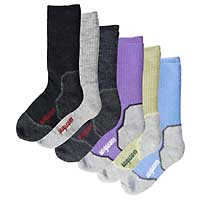
Even with the regular use that I have been given these I haven't seen any signs of thinning out or holes developing. Odour control is still good even after a years worth of use and washing. There was some minimal shinkage after the first couple of washes but nothing too dramatic. I started out running the socks through the normal cycle on the washer and then leaving them out to dry but after they accidentally got put in the dryer without any harm I just treat them like my other clothes.
Paid $15 at MEC in Victoria, BC.
Thursday, April 24, 2008
WigWam Merino Light Trail Socks

Tuesday, April 15, 2008
MEC Tarn 3 tent
 This is definitely not a one person tent! Another purchase from my aborted attempt at the Juan de Fuca Marine Trail. I'm not sure why I thought that this would be a good attempt for a solo attempt at the JDF.
The tent itself is bullet proof and stands up to a hell of a lot of bad weather without any problems. However, it weights 3.2 Kg (7 lbs) and doesn't pack down to a very manageable size. If there is two of you it is much better as one person can take the tent and fly and the other can take the poles and pegs.
The tent is roomy for two but three would be very cozy. The vestibule is big enough to get two packs into and still have enough room to get in and out comfortably. There is a window in the fly vestibule and a nifty zippered flap that you can poke your head out of to see if the weather has cleared up. There is a footprint available for it (which I have) but I haven't had a chance to use.
Set up of the tent is pretty easy. The tabs for the three poles are color coded so you don't try to put the wrong tab on the wrong pole. The fly is the standard type that stretches over and attaches to the bottoms of the poles.
Currently only using the Tarn if backpacking with other family members. Retired and replaced by a Hennessey Ultra Light A-Sym Hammock.
MEC Ibex 80 Backpack
 I purchased this pack in the spring of 2007 to use to attempt the Juad de Fuca Marine Trail. I hadn't done any significant backpacking since I was in my early twenties and figured that I needed something with a large volume and lots of pockets. I almost bought an Arc'teryx Bora pack but figured that I would save the extra money and purchase the Ibex 80 instead.
The pack itself is great but as I now know it is nowhere near being a lightweight pack. The empty weight for the standard length pack is 2.9 Kg (6.4 lbs) which is 3 times the weight of the Granite Gear Vapor Trail that I now have.
Tha pack is very well built and stands up to a lot of abuse. There are pockets everywhere on the thing so you should have no problems finding somewhere to put all of that gear.
The shoulder straps and padding on the back of the pack make it pretty comfortable even when hauling large amounts of gear. I had over 27 Kg (60 lbs) of gear with me for my attempt on the JDF and even though I came off the trail at the half way point it wasn't because the pack was uncomfortable.
If you are looking for an expedition grade pack and don't want to spend a wack of money this is the pack for you.
I still have the Ibex but for now it is retired.
SPOT Satellite Tracker

If you are like me, you have a spouse or partner that doesn't share your love of being out in the great outdoors and gets a little worried when you do go. The very nature of the places that we like to go to means that cell phone coverage is usually pretty spotty if not nonexistant. How cool would it be to have a small, light weight, long battery life device that could send a preconfigured email message to someone at the push of a button? That is what the SPOT Satellite Messenger does.
The device weights 209g (7.3 oz) and is waterproof to 1m for 30 minutes but it does float. The unit costs $169 CDN for the unit plus $100 USD/Year for the subscription. For this you get three functions: Check-in, Help and 911. When you press the Check-in button on the device an email is sent to an email address that you have setup before you left saying that you are OK, tells them your latitude and longitude and contains a link to Google Maps so they can see exactly where you are. The Help button sends a different message to an email address (which can be different than the Check-in email address) but it still contains your location and the Google Maps link. The 911 button sends a message directly to SPOT's emergency service provider who will then send out the closest help for you.
Coverage seems be everywhere in the world except for south Africa and India but I'm sure that will come. There are some extra services that you can subscribe to as well. For $50/year you can have progress monitoring and for $8/year you will be covered for up to $100,000 USD for the cost of your rescue.
There is a more complete review on Gearlog. You can purchase SPOT directly from their website or in BC from London Drugs.
I think I'll be adding this to my wish list.
UPDATE - April 22, 2008
I came across a thread on Backpacking Light that has some SPOT owners saying that OK and Help messages aren't getting through. This could be due to misuse by the owners but it doesn't sound like it. Maybe I'll wait for the version 2 product to come out instead.
UPDATE - May 14, 2008
I ended up buying a SPOT for the West Coast Trail 2008. I'll link to a review later.
